
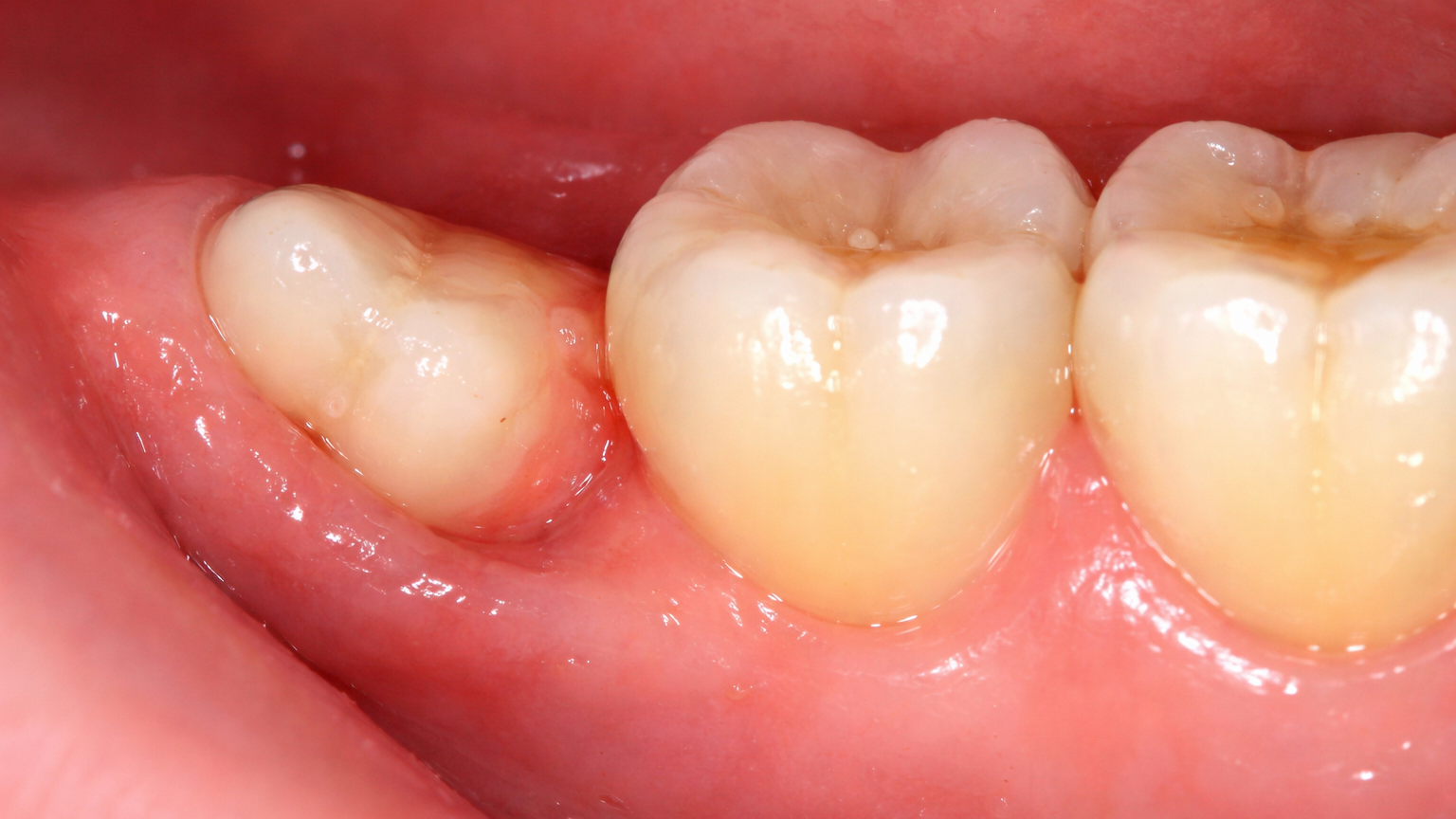
Image showing an impacted wisdom tooth pressed up against the second molar, with mild gum inflammation
A little bit about wisdom teeth
Wisdom teeth, or third molars, are the last set of teeth to develop in humans, typically emerging between the ages of seventeen and twenty-five. They are named for the period of life in which they appear, often associated with the transition into adulthood. Historically, these teeth served a practical purpose for early human diets that consisted of tougher, uncooked foods requiring significant chewing power. Over time, however, human jaws have become smaller due to evolutionary changes and dietary shifts, while the genetic instruction to develop wisdom teeth remains. This discrepancy between jaw size and the number of teeth is the central reason why wisdom teeth so often cause dental complications.
Not every person will require the removal of their wisdom teeth. If there is adequate space in the jaw and the teeth erupt fully, in proper alignment, and can be kept clean, they may remain in place without issue. However, a significant number of people experience impaction, where one or more wisdom teeth become trapped beneath the gum line or against adjacent teeth due to lack of space. Impacted teeth can grow at an angle, remain partially erupted, or become completely lodged within the jawbone. This condition can lead to a variety of problems, including localized pain, swelling, and infection of the surrounding gum tissue. Partially erupted teeth create an opening that is difficult to clean, allowing bacteria to accumulate and potentially cause pericoronitis, a painful gum infection. There is also a risk of cyst formation around the impacted tooth, which can damage bone and neighbouring tooth roots. Furthermore, wisdom teeth, even when fully erupted, are situated in a hard-to-reach area of the mouth, making them susceptible to decay and increasing the risk of cavities on the adjacent second molars.
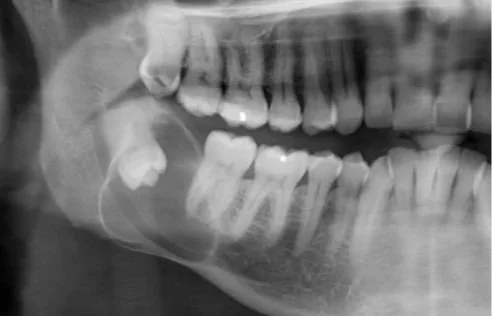
A large cyst attached to an unerupted wisdom tooth.
The decision to remove wisdom teeth is not automatic and is based on a careful clinical assessment. Dentists rely on dental examinations and panoramic radiographs to evaluate the position of the teeth, the presence of existing infections, and the likelihood of future problems. Extraction is generally recommended when there is evidence of disease, such as infection, cysts, or decay, or when damage to nearby teeth is likely. Preventative removal may also be advised for younger patients if the x-rays indicate a high probability of future complications, as the procedure and recovery are often simpler in late adolescence or early adulthood.
FAQs:
Q: “How painful will wisdom teeth surgery be? I’ve heard nightmares from my friends”
A: The surgery itself is common and performed under appropriate anaesthesia to ensure patient comfort by one of our experienced dentists. Post-operative care involves managing swelling and discomfort, adhering to a soft-food diet, and maintaining oral hygiene to ensure proper healing.
Q: “But I’m scared of surgery, can I be knocked out?”
A: Drs Adrian Tan, Jocelyn Lee and Tristan Ma are all certified to provide intra-venous sedation during wisdom teeth surgery to make your experience as pleasant (and forgettable) as possible. Click on this link to learn more about IV sedation and see if it suitable for you.
Q: “ How much will it cost? What are the risks? How long do I need to take off work?
A: These are all great questions! But as every individual case is unique we cannot answer these online and recommend you book a consultation with one of our dentists that are experienced in wisdom teeth surgery. The dentist will take a panoramic radiograph and take time to answer all of your questions. In some more complex cases, after analysing this x-ray, the dentist will then recommend taking a CBCT (cone beam CT scan) to given further, more detailed information in order to tailor a treatment plan for you. After this appointment, you dentist will be able to provide you with a written treatment plan detailing the cost of treatment, and before/after care instructions. This will enable you to make an informed decision about wisdom teeth surgery and if you wish, to then make an appointment for the proposed treatment.
Q: “What finance options do you have?”
A: Once you have been given a treatment plan by one of our dentists for your wisdom teeth removal, our friendly reception staff can discuss finance options; these include ZIP, GEM and Q-Card.
Q: “Can I get my wisdom teeth out on a Saturday or Sunday?”
A: In short, yes! Some of our dentists who do wisdom teeth surgery also have appointments available during the weekends. You just need to specify this when booking for an initial wisdom teeth consultation so that our friendly receptionists can book you with the appropriate dentist.